
Safety rails that keep the view
Deck Railings & Stairs in Honolulu, HI
Guards and stairs that meet code on raised and hillside decks, in materials that stand up to salt air.
- Free on-site estimates
- Written, itemized quotes
- Help with permit drawings and the DPP application
Rails and Steps Carry the Most Risk on a Deck
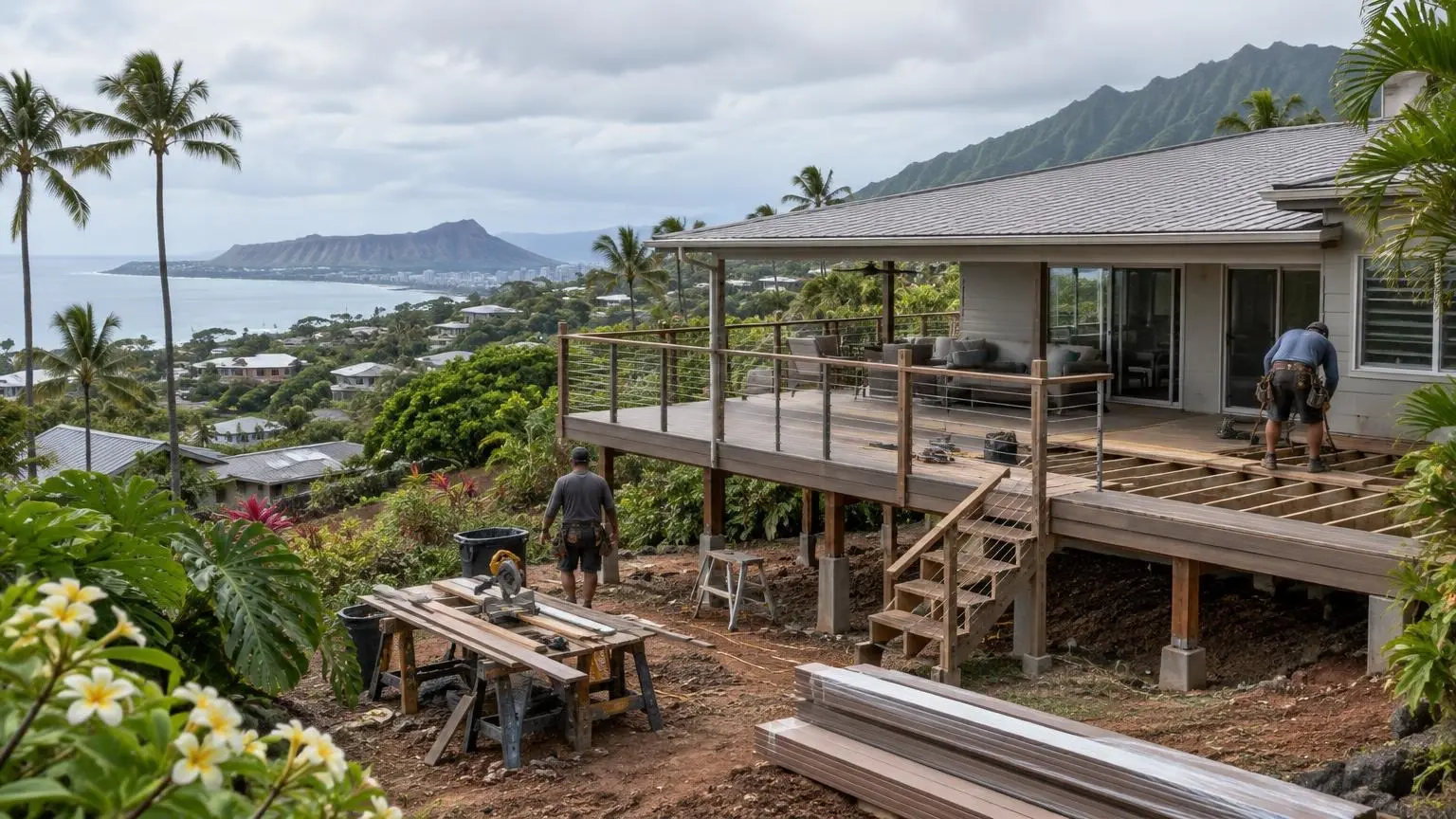
Deck railings and stairs are where a deck either feels safe or does not. On Honolulu's valley and ridge lots, decks often stand far above the ground, and a railing is the only thing between a guest and a long drop. It is also the part of the deck most people look through to see the view, so material choice is a balance between safety, sightlines and how it will look after years of sun and salt.
Code basics
Under the model residential code that most U.S. building codes follow, a guard is required where the deck is more than 30 inches above the ground. Residential guards must be at least 36 inches high, must not let a 4-inch sphere pass through, and the top must resist a 200-pound load. On stairs, the opening limit is slightly larger. Stairs also need handrails and consistent riser and tread sizes. We confirm the code Honolulu has adopted and draw the railing to it for the permit.
The post connection is what matters
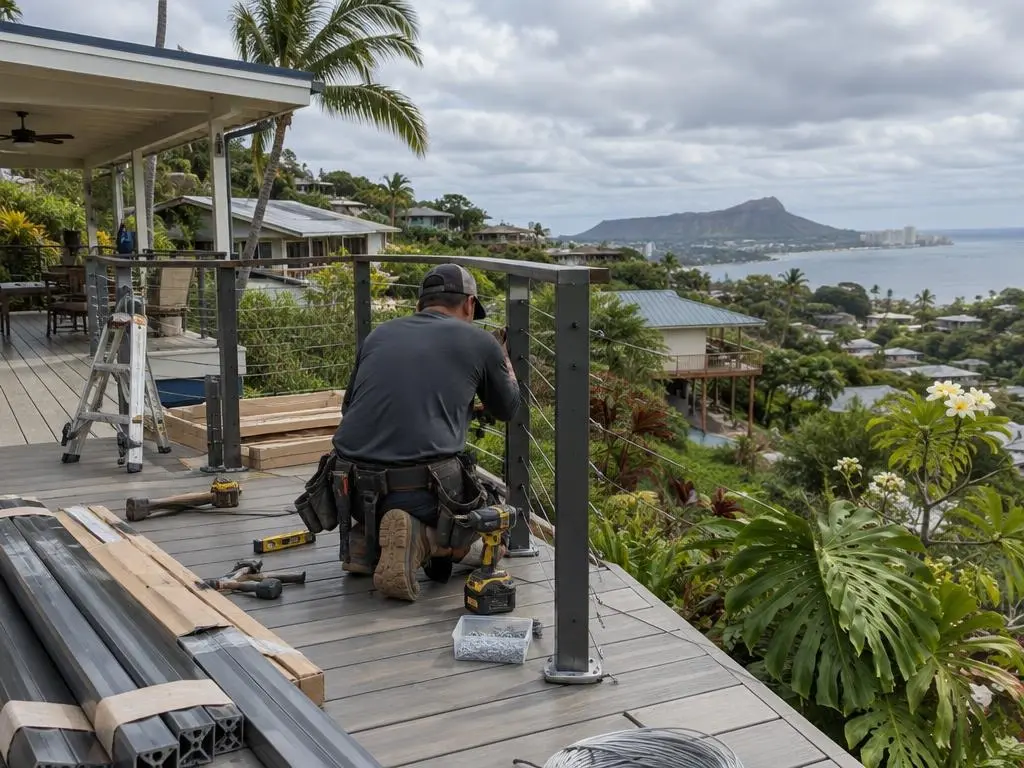
A railing is only as strong as how its posts are fastened to the deck frame. A post held with a couple of screws to a single rim board will loosen over time. We use through-bolts, blocking and tension-tie hardware so each post can take the required load, and we check existing posts the same way when adding new rails to an older deck.
Materials for Oahu
- Aluminum: light, does not rot or feed termites, and powder-coated finishes hold up well; a common choice near the water
- Cable: thin stainless cables keep views open; marine-grade stainless and correct tensioning matter in salt air
- Glass panels: the clearest view and a wind break on breezy decks, at a higher price and with more cleaning
- Composite and vinyl: match composite decking and need no staining
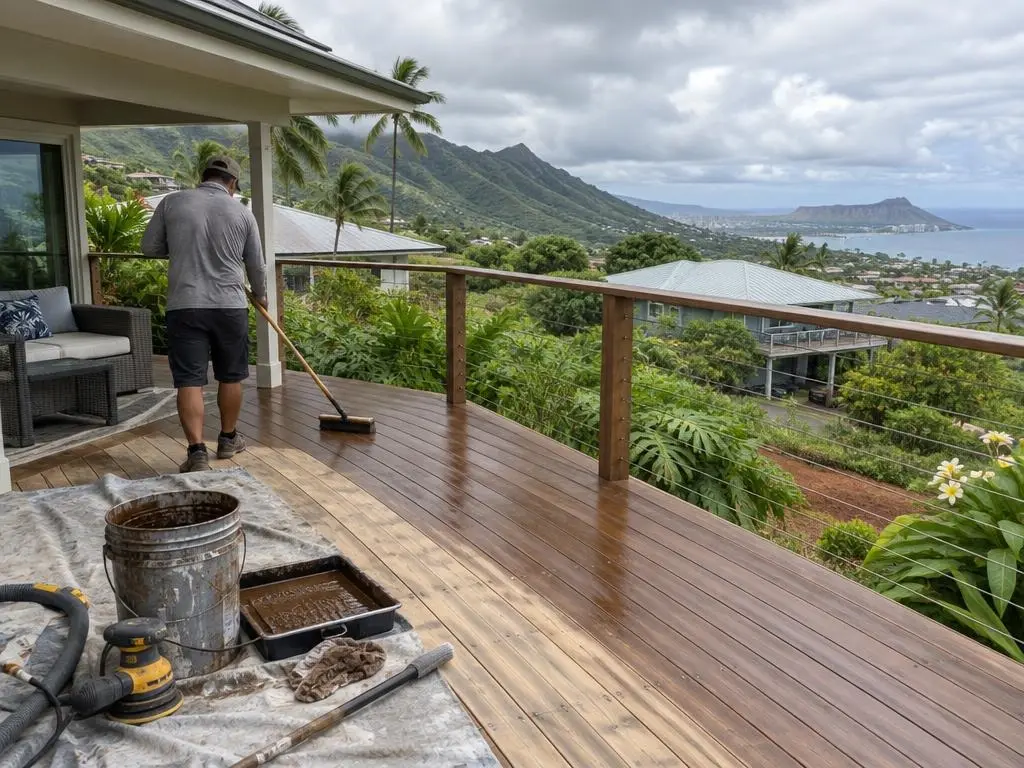
- Wood: the lowest cost and a classic look, with regular finishing under strong sun
Salt spray is the deciding factor for many oceanfront homes, so we talk about distance from the water before recommending metal parts.
Steps down a hillside
Hillside decks often need long stair runs, landings or a turn to reach the yard. Each stair needs a solid base at the bottom, usually a concrete pad, so the stringers stay off the soil and away from termites. Stringers on long runs may need intermediate supports. Stairs are also where poor drainage causes slips, so we pick tread surfaces with grip and leave gaps for water to clear.
Lighting
Post cap lights or riser lights make stairs safer after dark. Low-voltage systems are common; any line-voltage work is done by a licensed electrician. We plan wire paths before the rail goes on so nothing has to be cut in later.
Replacing old railings
Many older Honolulu decks have railings that are too low or have openings wider than today's 4-inch rule. Upgrading the railing alone is a common project and a good time to check the posts and rim board for termite damage.
What This Covers
Railing and stair work can be part of a new deck or a stand-alone upgrade.
Aluminum and composite railings
Low-maintenance systems in colors that match the deck.
Cable and glass railings
Open-view guards with stainless and marine-grade parts.
Deck stairs and landings
Straight runs, landings and turns for raised and hillside decks.
Railing upgrades
New guards on older decks, with post connections brought up to strength.
Railing and Stair Price Ranges
| Item | Installed, national range |
|---|---|
| Wood railing | $30 to $50 per linear ft |
| Metal railing | $45 to $85 per linear ft |
| Composite railing | $80 to $165 per linear ft |
| Cable railing | $115 to $175 per linear ft |
| Glass railing | $140 to $210 per linear ft |
| Deck stairs | $75 to $450 per step (Fixr); $25 to $50 per stair (Angi, 2026) |
Railing rows are Fixr's national installed ranges (last updated 2023); HomeAdvisor's 2026 guide gives $35 to $210 per linear foot overall. Stair figures differ widely between sources. Height, post spacing and stainless parts change the total. The price you pay is the one on your signed written estimate.
How It Works
1. Measure
We measure height, run length, post locations and stair rise.
2. Choose materials
You compare railing types for view, upkeep and salt exposure.
3. Strengthen the posts
Blocking and bolted connections go in before the rail.
4. Install and check
Rails, stairs and handrails are installed and checked against the drawings.
Deck Railings & Stairs Questions
What height does a deck guard have to be?
Under the model residential code most U.S. codes are based on, a guard is required when the deck is more than 30 inches above the ground, and residential guards must be at least 36 inches high with openings that block a 4-inch sphere. We confirm the rules for your deck with the city's adopted code.
What railing holds up best near the ocean?
Powder-coated aluminum and glass with stainless hardware are common choices. Cable railings work too if they use marine-grade stainless parts. Ordinary steel parts rust quickly in salt air.
Can I replace just the railing on my deck?
Yes. We check the posts and rim board first, since a new railing is only as strong as the frame it bolts to, and fix any termite or rot damage we find.
What does a new deck railing cost per foot?
National installed ranges run from about $30 per linear foot for wood to $140 to $210 for glass (Fixr). HomeAdvisor's 2026 guide gives $35 to $210 per linear foot overall. Once we have measured, you get a written price.
Deck Railings & Stairs Service Areas
- Deck Builders in Honolulu, HI
- Deck Builders in Kailua, HI
- Deck Builders in Kaneohe, HI
- Deck Builders in Hawaii Kai, HI
- Deck Builders in Aiea, HI
- Deck Builders in Pearl City, HI
- Deck Builders in Kapolei, HI
- Deck Builders in Ewa Beach, HI
- Deck Builders in Mililani, HI
- Deck Builders in Waipahu, HI
- Deck Builders in Wahiawa, HI
- Deck Builders in Waimanalo, HI
- Deck Builders in Manoa, HI
- Deck Builders in Kaimuki, HI
- Deck Builders in Haleiwa, HI
- Deck Builders in Kahala, HI
- Deck Builders in Makakilo, HI
- Deck Builders in Waianae, HI
Get a Deck Railings & Stairs Estimate
Free on-site measuring for railings and stairs on Oahu.