
Town to valley to ridge, across the urban core
Deck Builders in Honolulu, HI
Decks and lanai covers planned for leeward sun, salt-laden air and the Formosan termite, from Kalihi to Manoa to Hawaii Loa Ridge.
- Free on-site estimates
- Written, itemized quotes
- Help with permit drawings and the DPP application
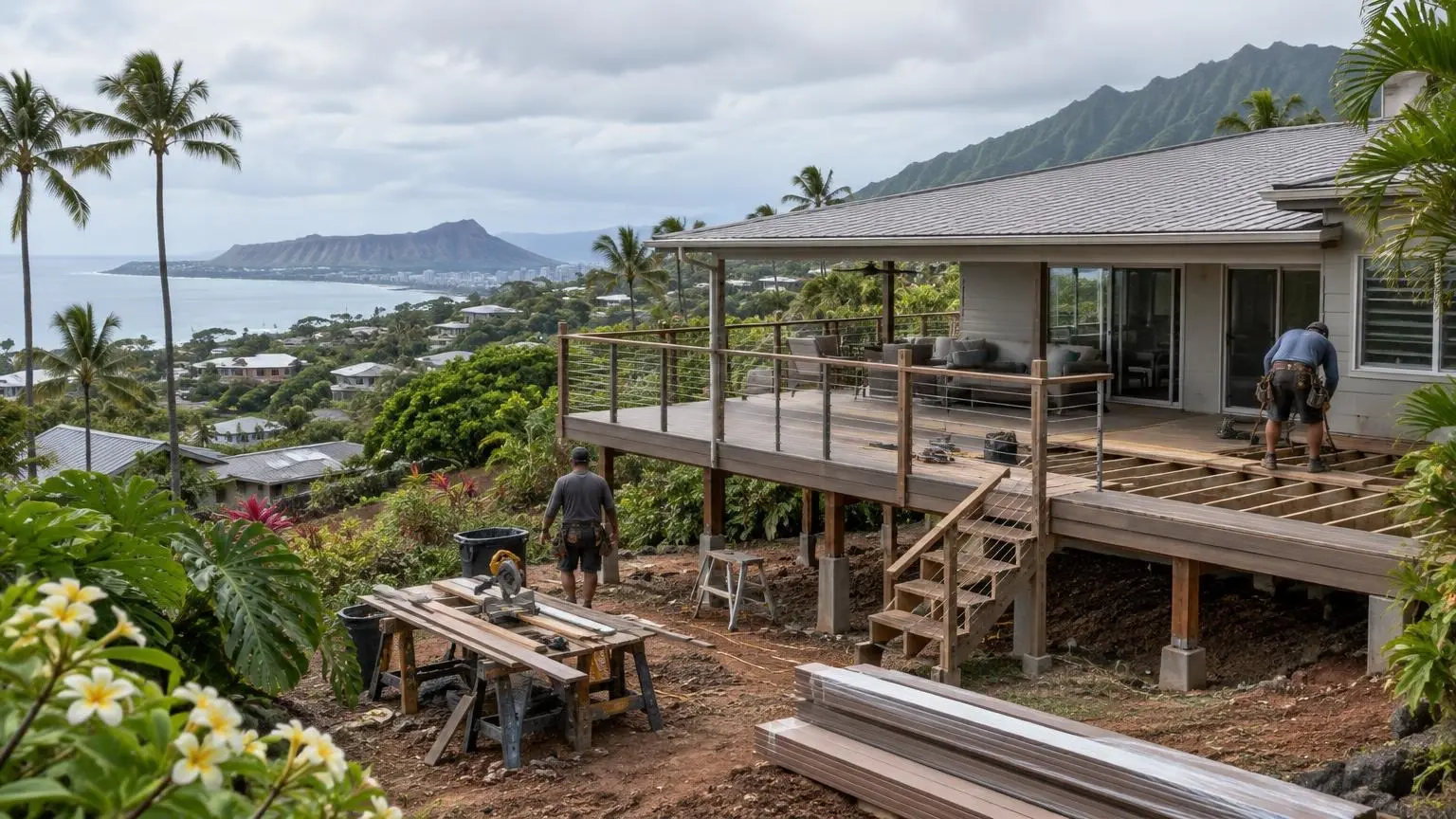
Building Outdoor Space in the City's Dry, Bright Climate
Deck builders in Honolulu have to plan for a climate that is drier and brighter than most people expect. Wikipedia describes Honolulu's climate as hot semi-arid, with an annual average of 16.41 inches of rain that falls mostly from October through early April and an average of 278 sunny days a year. That means the biggest enemy of a deck here is usually not standing water but sun: boards, stain and fasteners spend most of the year under a strong, direct overhead load of light and heat.
Sun is the first design input
Wikipedia's climate tables put Honolulu's average annual UV index at 9.6 to 9.7, with July and August peaking at 12.2 at the airport station. On an unshaded deck, that much exposure breaks down wood fibers, fades cheaper composites and dries out finishes faster than most mainland schedules assume. When we lay out a Honolulu deck we look at where the afternoon sun lands, whether a lanai cover or shade structure makes sense, and which surface stays comfortable to walk on barefoot. Lighter colored composite boards and a covered section near the door are common answers.
Valleys, ridges and tuff cones
Honolulu is not one flat lot repeated block after block. Manoa and Palolo valleys run inland side by side, Nuuanu and Pauoa sit inland of downtown, and neighborhoods like Salt Lake and Aliamanu were built in extinct tuff cones. East of Diamond Head, the gated communities of Waialae Iki and Hawaii Loa Ridge climb the hillsides. Each setting changes the build:
- Valley lots often slope toward a stream or the street, so posts may be tall on the downhill side and footings need careful placement.
- Ridge homes catch more wind, which affects railing choices and how a lanai roof is tied down.
- Crater neighborhoods can have tight yards and retaining walls, so a deck may be the only practical way to gain level space.
Termites and salt air in town
The University of Hawaii's termite research program calls the Formosan subterranean termite the most economically important insect pest in the state. UH guidance tells homeowners to remove any wood-to-soil contact and keep the perimeter clear so mud tubes can be seen. We build that in: concrete footings, posts held off the ground on metal bases, and enough clearance under the deck to inspect. Near the harbor and the south shore, airborne salt is the other factor. Simpson Strong-Tie notes that chloride deposition rates in Hawaii should be considered when choosing connectors, and it recommends Type 316, 305 or 304 stainless steel for certain treated-wood conditions. We match hardware to how close your home sits to the water.
What we build in Honolulu
- Composite decks for low upkeep under heavy sun
- Wood decks in species and treatments suited to outdoor use
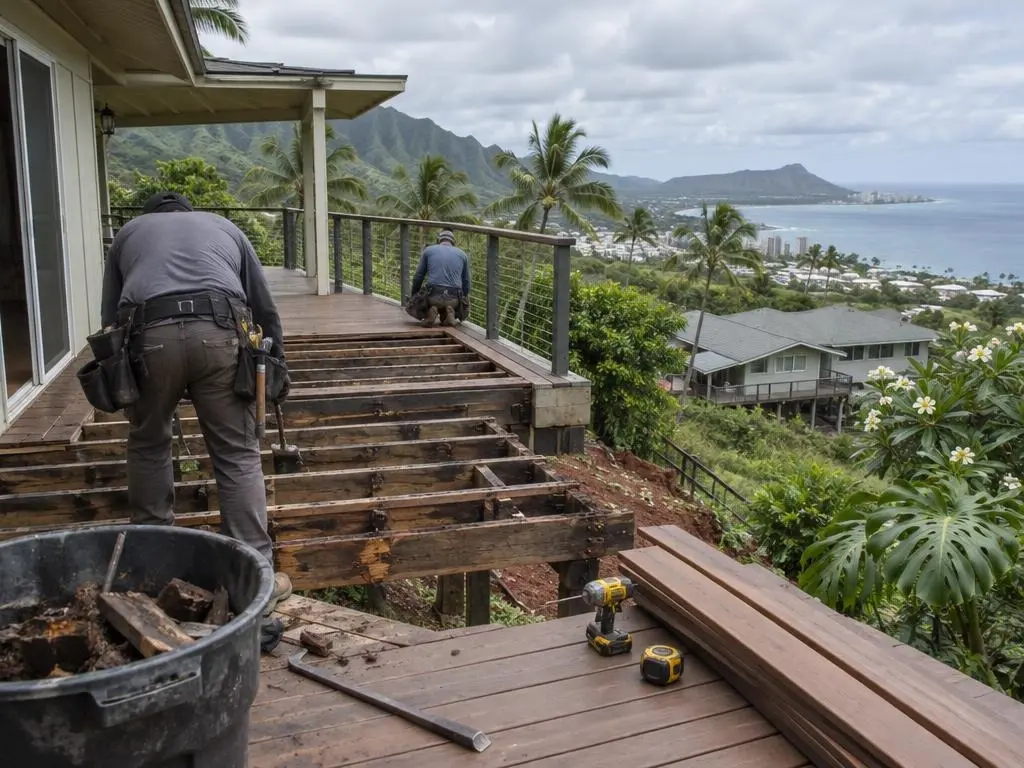
- Repair and full replacement of aging or termite-damaged decks
- Covered decks and lanai covers for shade and passing showers
- Railings and stairs, including tall stairs on sloped lots
- Cleaning, staining and sealing of existing wood decks
Condos, rentals and long-term owners
Census estimates put Honolulu's owner-occupied housing rate at 48.9 percent, so roughly half of households rent. If you own a townhouse or a unit in a managed building, check your association's rules on exterior changes before planning a new deck or lanai cover; many require approval of materials and colors. The same Census tables show 85.4 percent of residents living in the same house a year earlier, so many owners are planning for the long haul rather than a quick resale.
Permits through DPP
The city's Department of Planning and Permitting states plainly that a deck needs a building permit under ROH Chapter 18, and that the time to get one is highly variable. We talk through the permit step at the first visit so the schedule is realistic. To start, call (808) 509-2733 or request a free on-site estimate. You get a written, itemized quote.
Honolulu Facts That Shape a Deck
- Dry, sunny leeward climate. Honolulu averages 16.41 inches of rain a year, mostly from October through early April, with about 278 sunny days. Little summer rain means sun exposure, not rot from constant wetness, is the main wear factor.
- High UV most of the year. Wikipedia's climate tables list Honolulu's average annual UV index at 9.6 to 9.7, and the airport station table shows 12.2 in both July and August. Finishes and boards should be chosen with that in mind.
- Half owners, half renters. The Census reports a 48.9% owner-occupied housing rate for the Urban Honolulu CDP (2020 to 2024) and 85.4% of residents living in the same house a year earlier, across 136,902 households.
- Permit required for decks. The Department of Planning and Permitting's FAQ states that a deck requires a building permit under ROH Chapter 18 and that processing time is highly variable, depending on plan completeness and the department's backlog.
- Formosan termite pressure. UH Manoa's termite project calls the Formosan subterranean termite the most economically important insect pest in Hawaii. UH guidance says to remove wood-to-soil contact and notes swarming peaks in May and June.
Honolulu Questions
Which deck material holds up best in Honolulu's sun?
With close to 280 sunny days a year and UV levels near the top of the scale for half the year, we lean toward capped composite boards in lighter colors, or a well-sealed hardwood with a realistic maintenance plan. Darker boards can get uncomfortably hot underfoot in summer, so we bring samples you can leave outside for a day before deciding.
My house is on a steep lot in Manoa or Palolo. Can I still get a deck?
Usually, yes. Sloped valley lots often need taller posts, deeper or larger footings and sometimes engineered drawings, but they are also where a deck adds the most usable space. We look at the slope, drainage paths and access for materials during the estimate visit.
I live in a townhouse. Who approves a new lanai cover?
In addition to the city building permit, many associations require approval for exterior changes such as roofs, railings and colors. Ask your association for its architectural guidelines; we can provide a written scope and material list for that review.
How do you keep termites out of a new deck?
We keep wood off the soil entirely: posts sit on metal bases set in concrete, and the area under the deck stays open enough to inspect for mud tubes. Framing and boards are chosen for exterior use, and we point out any spots where the deck meets the house that should be checked each year.
Free Estimates in Honolulu, HI
Free on-site estimates anywhere in Honolulu, with a written, itemized quote.
Deck Builders Near Honolulu
- Deck Builders in Kailua, HI
- Deck Builders in Kaneohe, HI
- Deck Builders in Hawaii Kai, HI
- Deck Builders in Aiea, HI
- Deck Builders in Pearl City, HI
- Deck Builders in Kapolei, HI
- Deck Builders in Ewa Beach, HI
- Deck Builders in Mililani, HI
- Deck Builders in Waipahu, HI
- Deck Builders in Wahiawa, HI
- Deck Builders in Waimanalo, HI
- Deck Builders in Manoa, HI
- Deck Builders in Kaimuki, HI
- Deck Builders in Haleiwa, HI
- Deck Builders in Kahala, HI
- Deck Builders in Makakilo, HI
- Deck Builders in Waianae, HI